

If you happen to keep track of the seemingly never-ending Middle Eastern conflicts, you may find this post interesting. Evidently, there are no winners, only losers. However, if you were to assess who lost the most, that would be the Yazidis and Kurds communities. They are perpetually at the receiving end of the wars that have been running for decades now. Their men get killed, and women get sold. Very unfortunate, indeed, and I hope this conflict ends soon and the desert will settle the score eventually.
The term Kurd was not unfamiliar before this conflict; however, at the time, Yazidis did not ring a bell to many. Only after targeted persecution did the scholars and academics scramble to research every bit of information that they could find. This also means that the mainstream media and their collective knowledge on this topic are less than a decade old.

I was going through a few of the documentaries on Yezidism and Yazidis in general. The first thing that came to my mind was this community seemed to have been trapped at that location in a time capsule. If you evaluate their culture and practices, it is evident that they obviously do not belong to that region. Whatever the little assimilation to local culture seems to have been achieved with the only purpose of living in harmony. This obviously never worked and has been proven from time to time.
Remember the Kalash tribe we spoke about?
The academics’ conclusions seemed hurried in the available documentaries and were taken based on the surface information available to them. They unimaginatively concluded without attending to outliers or information, which are many. Of course, I did not do as much research as those. But It does not require rocket science to see the pattern amongst linguistic and geological evidence, which nearly conclusively places them where they are currently present. Even then, a few things do not add up, and I am shocked to find no mention of these facts in any documentaries.
Okay, this is a list of topics related to Yazidi cultures with the first look at documentaries. I hope some of those academics stumble upon my post and consider answering these strange correlations.
Religious Beliefs
- It’s an oral, documented and transferred religion. Yazidis pass on their myths through inheritance. There is no centralized text. Just like Vedic texts, they were propagated through inheritance.
- They have angels called Heft Sur. A basic understanding of Persian and Sanskrit can translate what it is – seven gods. Hefte is a Persian word with Sanskrit origin of Sapta for seven. During ancient ages, Indians called their gods Sur and demons Asurs. Exactly then, understandably, Persians called Gods as Asur’s and monsters as Sur. If you were asked to put a straightforward logical conclusion, where would you put Yazidis?
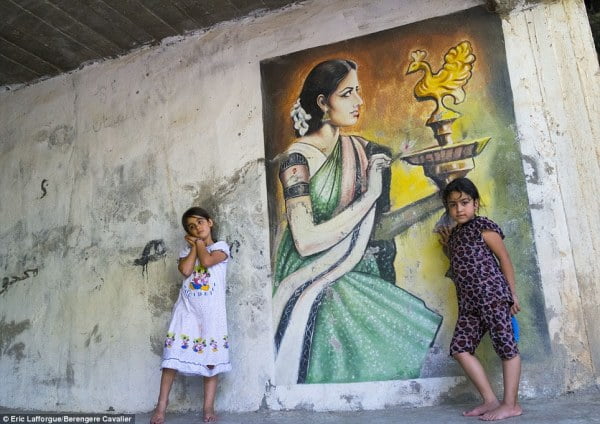
- They believe in seven angels, the most important being Melek Tawus, a peacock. Here is an interesting trivia for you. Peacocks never existed in the Kurdish region. If you need to find one, you need to travel east till you reach… You guessed it right! Indian subcontinent.
- Emanations, I.e., God, emanates as 7 transcended angels (haft Sur), which sounds very similar to avatars. This is a remarkably similar concept to that of neighbouring Zoroastrianism.
- Reincarnation is based on karma in the current incarnation.
Architecture and artefacts
- The template towers mysteriously resemble conical shapes.
- Snakes guard the temple entrance.
- The peacock lamp looks like the one Samay used in Indian traditions.

Practices
- They do not allow themselves to marry outside the religion or, most importantly, into it. It’s forbidden to convert out or in.
- Prayers are directed towards the sun. Sunrise. And sunset aligning the Sandhya Vandana.
- Castes. Marriage must be within the same group.
- Use of fire in religious practices, including an Aarti.
- Practice tilak/bindi between the brow and the forehead.
- Salute with folded hands.
The list goes on and on.
Let me know what you think.
 The Bach
Very interesting !! I read the book by Nadia Murad “The Last Girl” and was wondering about the similarities between Yazhidi Gods and ours. The sad fact is no one in the world cares about these kinds of tiny marginalised communities that are getting terrorised into adopting either Islam or Christianity.
LikeLiked by 4 people
Bindu, thanka very much and thanks for stopping bu
LikeLike
That’s a really interesting blog post. Many thanks for sharing.
LikeLiked by 3 people
Thanks Paul, appreciate it.
LikeLiked by 1 person
A very informative post. Interesting read. Thanks 🙏
LikeLiked by 2 people
Thanks KK, it was pleasure researching
LikeLiked by 1 person
Loved reading this post, thank you sharing your knowledge about this community. Just wondering if there is any similarity between Yazidis and the gypsies of Europe?
LikeLiked by 3 people
Possible… Gypsy’s find their ancestors in Rajasthan state of India , their gene , culture and language have some resemblance . Possible that while migrated few tribes stayed back in middle East and rest continued their journey to the eaurope.
Thanks sharmaji for dropping by.
LikeLiked by 1 person
That’s a possibility, I believe. It was a pleasure to read your blog!!
LikeLiked by 1 person
Thanks Deepak, have a nice weekend.
LikeLiked by 1 person
Yes you are right… List goes on…
LikeLiked by 3 people
Thanks Aman welcome to my blog
LikeLike
Informative post my friend❤
LikeLiked by 2 people
Thaanks Noorie.. interesting name. You have a fantastic blog.
LikeLike
Thank you dear😊❤
LikeLiked by 1 person
Oh this is very interesting. I like how you linked to the origin of the peacock to an earlier post about turkeys.
LikeLiked by 2 people
Thanks Digital Empire…. Appreciate it
LikeLike
One wonders if they arrived to the Middle East as nomads, slaves, or during a diaspora. This would be well-worth investigating. Has there been any scholastic interviews of elders?
LikeLiked by 3 people
I could not find much on internet. Let’s hope there is some good research and world will come to know.
Have a nice weekend swabby
LikeLike
I appreciate you sharing your thoughts with us.
LikeLike
That was very interesting! Never even imagined Yezidi’s culture is so similar to Hindu culture. Well articulated research 👍 good job Bach 😊
LikeLiked by 1 person
Thanks Chiru. Hope you are the same Chiru I know.
LikeLike