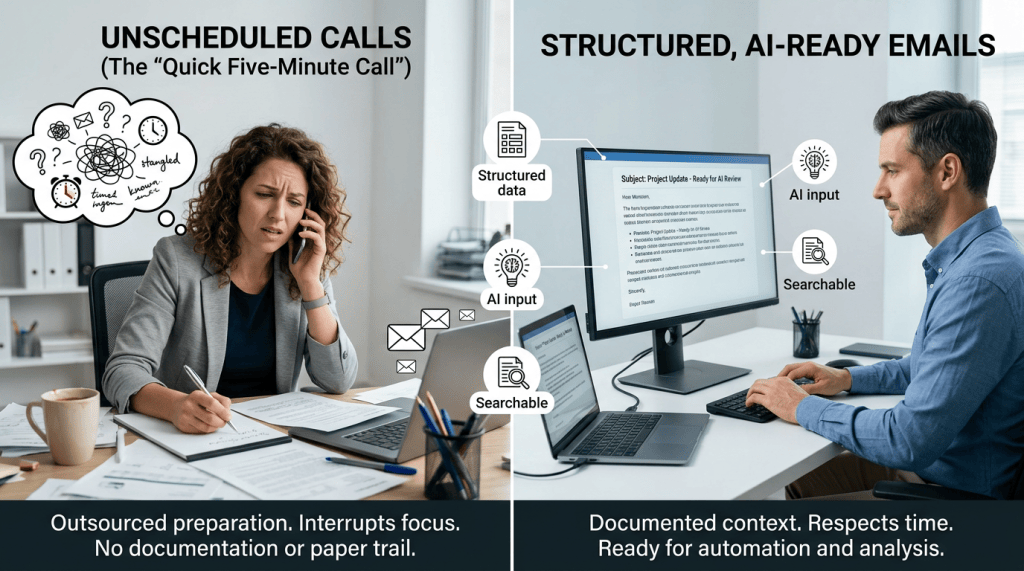
Corporate culture loves to romanticise and glorify the “quick five-minute phone call”—usually proposed by someone who has zero respect for the forty-five minutes of deep focus you were just having, perhaps on a deep computation and even planning the entire next year.
We have all been conditioned to treat picking up the phone as a badge of grit, decisiveness, and high-touch leadership. Yet in reality, it’s often just hitting the dial without warning. More often than not, has nothing to do with urgency. Dialling a number gives the caller an immediate hit of momentum, while forcing the me into an unscheduled interruption, scrambling for context that I do not have in front of me. Most of the “urgent calls” are never emergencies; they are simply outsourced preparation. Writing a crisp three-bullet email forces you to organise your thoughts beforehand. Making an unscheduled call lets you think out loud on someone else’s clock.
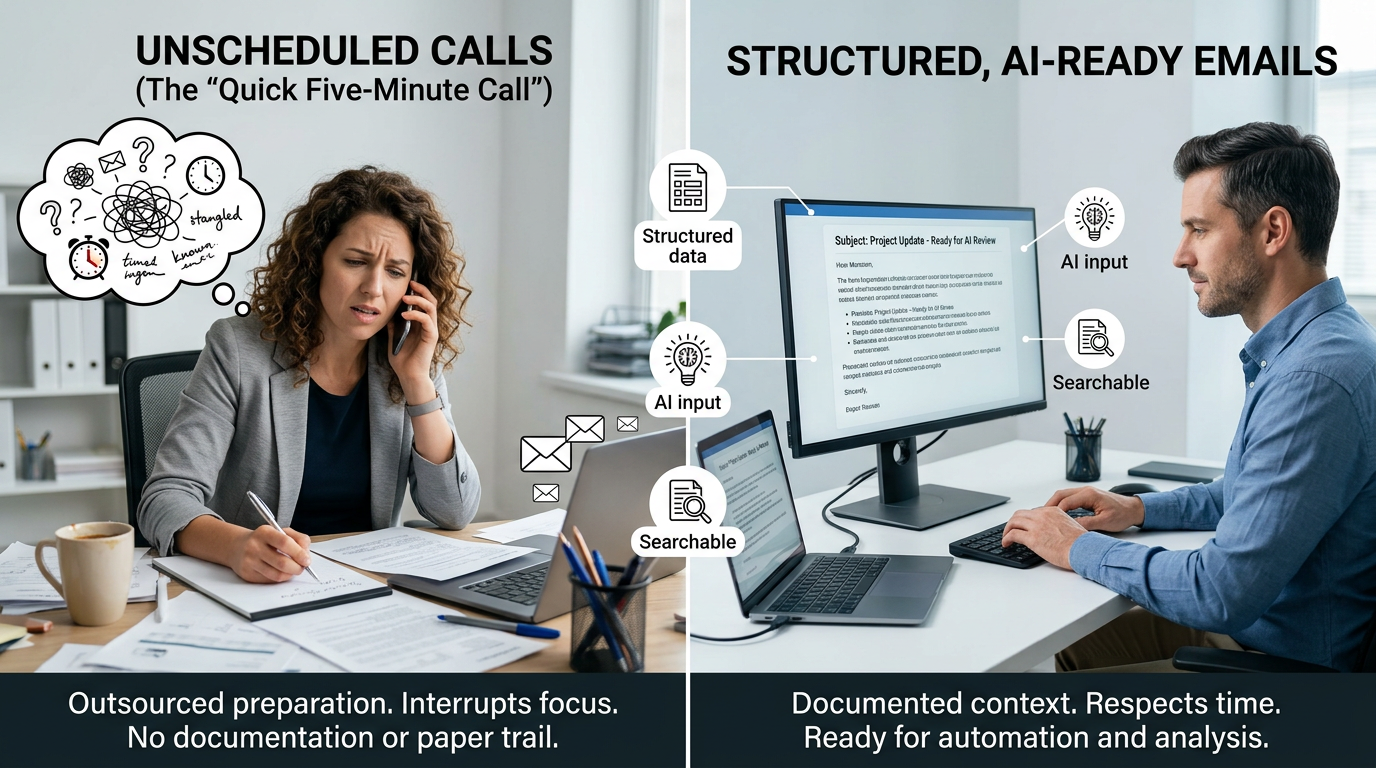
Part of this obsession comes from old-school management folklore—a habit inherited from an era before searchable threads and shared documents, when the alternative to a call was waiting days for a letter or a fax. In modern workplaces, however, people often prefer calls for a quieter reason: the accountability loophole. Unrecorded voice calls leave no paper trail. You can make vague promises, dodge hard commitments, and subtly shift the goalposts next week without a timestamped thread proving what was actually agreed.
A well-structured email with the right stakeholders in CC does the exact opposite.
- It respects asynchronous time, letting people review and reply when they are actually in the right headspace rather than assuming everyone is sitting around waiting for your ringtone and your pretty voice.
- It aligns an entire group simultaneously without turning it into a messy game of corporate telephone.
- It creates an indisputable audit trail—and in an era of AI assistants and Copilot, that structured text carries a massive unfair advantage. Software can summarise a fifty-message thread, track delayed action items, and automate follow-up reminders, whereas an unrecorded phone call remains invisible dark data.
“People don’t just romanticise phone calls for the ‘personal touch’—they love them because voice leaves no paper trail when the goalposts move.”
Of course, email purists, such as me, are not immune to their own blind spots. Using email to “multitask” while half-listening on low-priority status calls usually just means doing two things poorly—triage works, deep thinking does not. Similarly, firing off passive-aggressive follow-up nudges to pressure delayed tasks can quickly turn into inbox warfare that people simply learn to tune out.
The answer is not to ban the phone altogether, but to invert our default. Keep email as your primary engine for alignment, gentle governance, and, most importantly, an institutional memory. Reserve a three-minute voice call strictly as a circuit-breaker—when an email thread hits two rounds of misunderstanding, when emotional friction needs vocal warmth, or when a chronic non-responder needs a live nudge to uncover what is actually blocking them. And the moment you hang up? Send a two-line “per our call” email to lock it into the record.
Maybe Gen Z’s notorious reluctance to answer phone calls is not social anxiety after all. Perhaps they just figured out sooner than the rest of us that a ringing phone is usually an unscheduled interruption disguised as urgency.
Where do you stand—are you Team “Let’s Hop on a Quick Call” or Team “Put It in an Email”?